
Nine Organizations Complete JCSI Cohort 4, Bring $90,000 in New Security Funding to the Community
09/08/2026
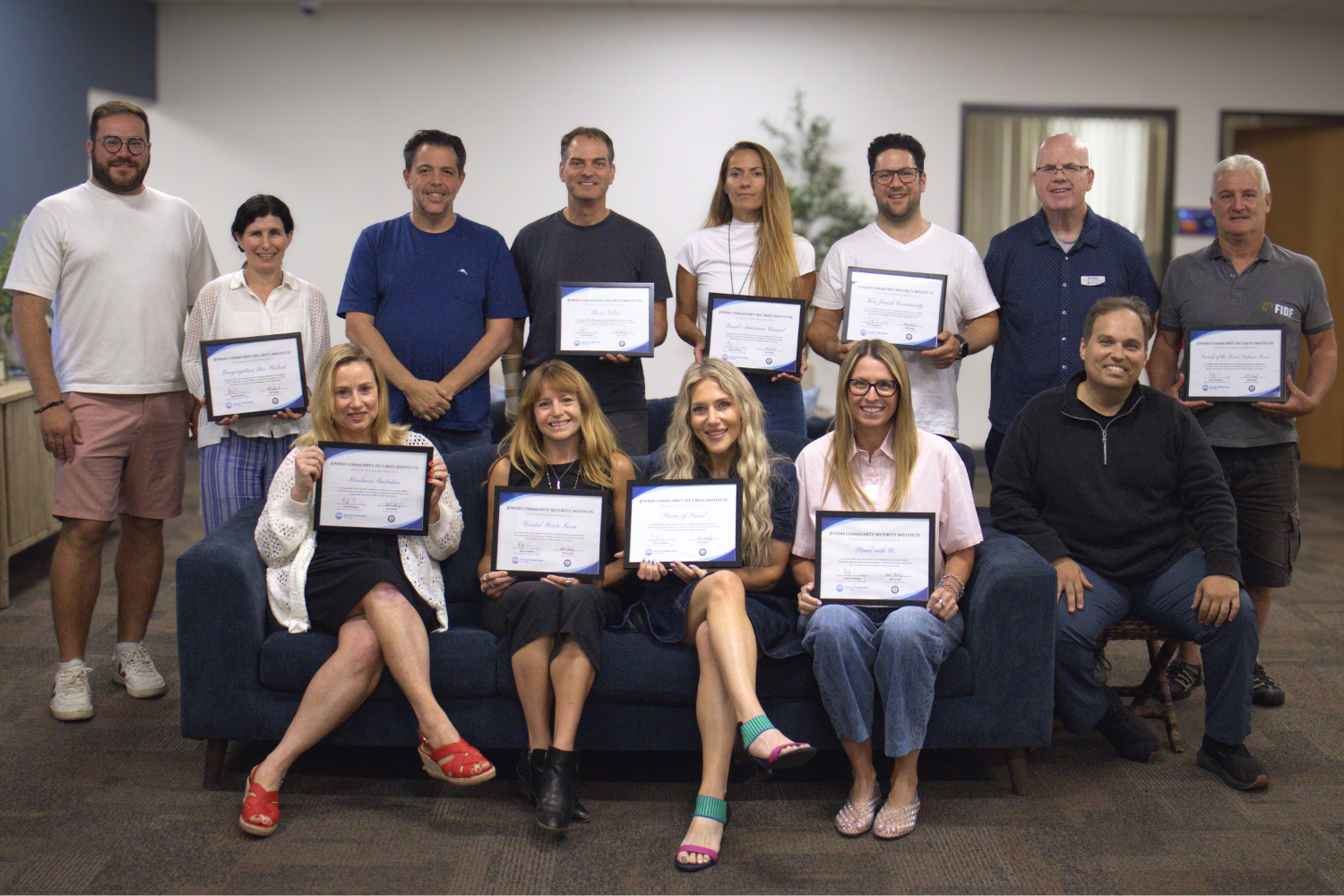
Security is not just about guards and gates. It is about being prepared and being vigilant. That is why the Jewish Community Security Institute (JCSI) just wrapped its fourth cohort of intensive security training for community leaders and institutions.
Fourteen professionals and lay leaders from nine San Diego Jewish organizations graduated last Friday. Every participating institution was awarded a $10,000 security grant on completing the training and final evaluation, putting $90,000 of new security funding into the community.
Security Without a Building: Preparing for a Community That Moves
Cohort 4 was designed around a specific challenge: much of the standard guidance for community security assumes an organization has a permanent facility. There is a lobby to control. Doors to harden. Cameras to install. A perimeter to monitor.
But a large share of Jewish life in San Diego does not work that way. Programs take place in rented rooms, public parks, campus spaces, member homes, and venues booked for a single event.
These organizations face the same threat environment without many of the same physical security tools. They cannot install an access control system in a space they will occupy for four hours. Their security posture has to travel with them.
That makes planning, vendor relationships, event protocols, situational awareness, and communications discipline all the more important.
Six Sessions, One Practical Security Framework.
JCSI is not a lecture series.
Over six sessions, the cohort worked through the material that professional community security directors use, and each session ended with something participants could take back to their own organization.
The curriculum moved from orientation into cybersecurity, event planning, situational awareness, emergency operations planning, and finally crisis communications. That order is deliberate. It follows the FEMA Integrated Preparedness Cycle, and it reflects a hard-won lesson from the field: governance and assessment come before any single-threat plan is worth writing.
The program equips organizations with tools across three areas: crisis response, strategic planning, and long-term safety upgrades. By the final session, participants had begun filling in an Emergency Response Plan, scoring hazards on a Community Security Risk Register, and drafting a Crisis Communications Plan for their organization. These are not hypothetical exercises. A completed threat, vulnerability, and risk assessment is a requirement for Nonprofit Security Grant Program applications, which award up to $150,000 per site.
The story you tell in the first hour
The graduation received a special session on public relations and crisis communications management led by Ashley Bendas, Senior Director of Marketing & PR at Jewish Federation of San Diego.
Her argument was straightforward. In a crisis, the facts are established by first responders, but the story is established by whoever speaks first and whoever speaks clearly. Organizations that have not decided in advance who can activate a response, who talks to reporters, and where staff and families go for accurate information end up making those decisions in the worst possible conditions: under time pressure, with incomplete information, and in public.
Bendas walked the cohort through the components of a crisis communications plan, including activation authority, role assignments, a notification order, pre-written statement templates, and a single source of truth that members and media are both pointed toward. Her point to a room of organizations without a front desk or a facilities team was that communications may be the single most portable security capability they have. It costs nothing to build in advance, and it is the piece most often missing when something goes wrong.
She encouraged every graduate to complete the plan on a quiet afternoon and to revisit it every time a staff member changes roles.

Nine Organizations, One Connected Community
Cohort 4 included staff and leaders from Shevet Galim-Tzofim, Israeli-American Council, Coastal Roots Farm, Kindness Initiative, The KEN Jewish Community, House of Israel, Friends of the IDF, StandWithUs, and Dor Hadash.
That range matters. A scout movement, a farm, and an advocacy office face different threats and hold different resources, but they share a community and, increasingly, share threat information. The professional relationships formed across a cohort are part of the point.
Congratulations to the graduates of Cohort 4:
- Deon Schaffer, Shevet Galim-Tzofim
- Sharona Shteienberg, Israeli-American Council
- Kesha Dorsey, Coastal Roots Farm
- Kristen Ruth, Kindness Initiative
- Yael Yaffe, The KEN Jewish Community
- Ari Sacal, The KEN Jewish Community
- Shay Kleinberg, The KEN Jewish Community
- Stephanie Nisan, House of Israel
- Jack Maizel, House of Israel
- Brian Blacher, Friends of the IDF
- Ashley Levy, StandWithUs
- Liat Cohen Reiss, StandWithUs
- Rabbi Mike Rothbaum, Dor Hadash
- Rabbi Allie Jacobson, Dor Hadash
Building Security That Lasts
The Institute’s curriculum is built on material developed by Secure Community Network (SCN), the official safety and security organization of the North American Jewish community and is taught in partnership with SCN staff.
We are grateful to Bill Ganley of SCN for sharing his expertise and time throughout the cohort.
Every graduate also left the program with an Organizational Security Binder: 17 documents organized across seven sections covering governance, risk assessment, funding, threat-specific playbooks, cybersecurity, and personal safety for leadership and staff.
The goal is not simply to complete six training sessions. It is to leave with the plans, relationships, and resources needed to make security an ongoing part of organizational planning.
Ready for Cohort 5?
Security preparedness is a community responsibility, and every organization can take steps to become better prepared. If your organization has not yet participated in a JCSI cohort, now is the time to get started.
Join the waitlist for Cohort 5 by contacting Matt Goldberg, Director of Caring and Community Relations.